Waves of Resistance Against Imperialism and the Extractivism of Ocean Resources: Highlighting Women’s Human Rights and Trade and Economic Justice
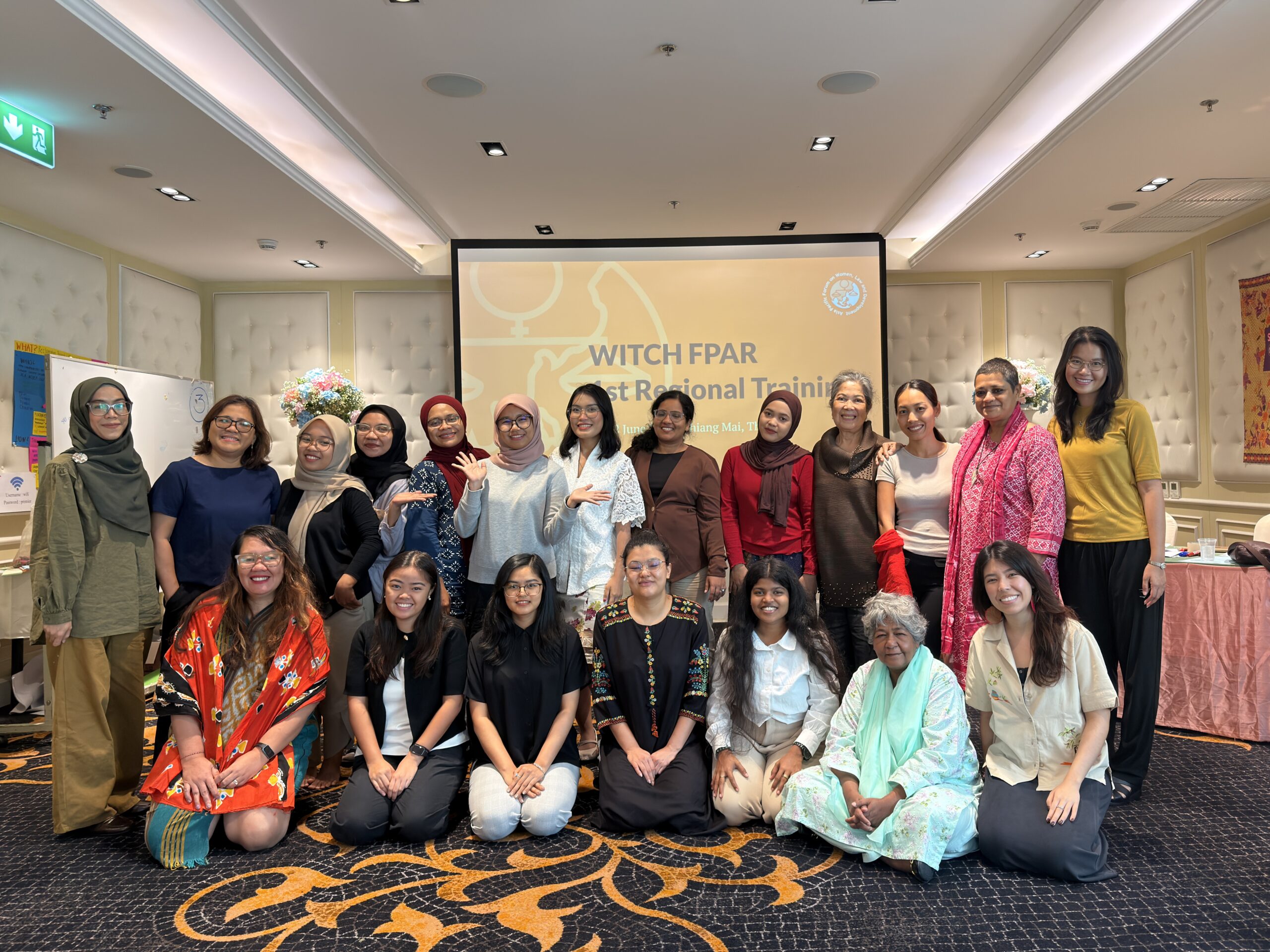
APWLD launches Women Interrogating Trade and Corporate Hegemony (WITCH) Feminist Participatory Action Research (FPAR) with six organisations
The Women Interrogating Trade and Corporate Hegemony (WITCH) programme of APWLD is launching a new Feminist Participatory Action Research (FPAR) for 2026-2027. The objective of the WITCH FPAR is to strengthen grassroots women’s movements to ensure that trade and investment agreements in the region adhere to human rights obligations and incorporate the voice and demands of Asia-Pacific women on Development Justice.
Marine resources are quickly becoming a new frontier for extractivism. The Blue Economy as a neoliberal economic agenda is a new form of colonialism that deepens unequal power relations and structures facilitated by globalisation, reproducing colonial patterns of debt dependency and commodifying the commons, putting additional pressure on the public, particularly women. This WITCH FPAR cycle is titled “Waves of Resistance Against Imperialism and the Extractivism of Ocean Resources: Highlighting Women’s Human Rights and Trade and Economic Justice.” The FPAR is looking into trade, militarism, corporate capture, and the introduction of neoliberal policies to expand further and extract resources, and their impact on different communities, particularly women.
1. Women’s Resource Center of Visayas, Inc. , Philippines
Born from a fierce 1980s awakening against the Marcos dictatorship and systemic oppression, the Women’s Resource Center of Visayas, Inc. was established on May 2, 1991, to champion the rights of marginalised women. Evolving from a local initiative into a regional powerhouse, the organisation aggressively drives grassroots empowerment through information and awareness campaigns, research, capacity building, and transformative education across marginalised communities in Cebu and the whole of Visayas in the Philippines.
2. Yayasan Bestari Nusantara, Indonesia
Yayasan Pramana Bestari Nusantara is a social non-governmental organisation dedicated to strengthening civil society through research, advocacy, and community service. We are committed to building an inclusive and fair social ecosystem in eastern Indonesia. We operate integratively based on the following strategic pillars. Human Rights and Civil Liberties, for protecting the fundamental rights of society and strengthening the democratic space. Indigenous Community, for preserving identity and respecting indigenous rights. Environment, supports environmental sustainability and protects environmental defenders. And of course Women’s Education and Empowerment, for increasing literacy and the role of women in the public sphere.
Our intervention focuses on indigenous communities, women, environmental defenders, and other vulnerable groups that need access to justice and independence. Last but not least, working with alliance organisations such as AGRA (agrarian), FMN (education), LSP (feminist), LSBH (legal), and Asli Mandalika (local community), makes our Yayasan participate a lot in several activities scheduled by them.
3. WALHI Maluku Utara, Indonesia
Throughout its more than 20 years of existence, WALHI North Maluku has consistently provided support and advocacy for communities affected by extractive industries, such as mining. In four years, we have focused on assisting residents of Obi Island (South Halmahera) and Weda Bay (Central Halmahera) who are struggling to safeguard their livelihoods and food sovereignty against two bigs industrial involved in National Strategic Projects (PSN) for nickel extraction, PT Harita Nickel and the Indonesia Weda Bay Industrial Park (IWIP).
4. Organisation from Burma/Myanmar
The organisation was formed to promote youth empowerment and social justice and initially conducted community research, public seminars, and training in rural areas impacted by extractive industries. Due to recent political instability, our work has more focus heavily on community education, establishing a school, and offering a range of academic and vocational education programmes that bridge learning opportunities to support rural youth.
5. The Penn Collective Trust, India
The Penn Collective Trust is a non-profit, non-partisan, public charitable trust committed to strengthening democratic participation and advancing gender-just, inclusive leadership across governance structures in India since 2023. The Penn Collective aims to redefine the socio-political spaces by equipping women with the skills necessary for meaningful political engagement, fostering a strong community of women leaders. Our mission is to nurture, equip, and sustain a diverse pipeline of socially conscious leaders, particularly women and gender minorities from historically marginalised communities, through education, research, behavioral-change communication, mentorship, advocacy, and ecosystem-building, grounded in constitutional values of equality, dignity, and justice.
6. Persatuan Aktivis Sahabat Alam (KUASA), Malaysia
Persatuan Aktivis Sahabat Alam (KUASA) is an environmental justice organisation based in Perak, Malaysia, dedicated to advancing environmental justice, climate resilience, and community empowerment. Through campaign, advocacy, research, training, and grassroots engagement, KUASA works to protect the environment, forests & coastal ecosystems while promoting environmental democracy, sustainable livelihoods and policy reform. The group collaborates with affected communities to resist environmentally harmful projects such as deforestation, coastal reclamation and other unsustainable development projects. Its mission is to ensure that environmental protection goes hand-in-hand with social justice and the rights of people to a healthy environment