
Since the early 1900s, International Women’s Day has been both a commemoration and a call to resist and organise. March 8 was born when working women rose up against exploitation, hunger, poverty wages and political exclusion. It was forged in strikes and uprisings, not celebration.
Today, in Asia and the Pacific, that call to resist is urgent.
The majority of women in our region are rural, Indigenous, peasant, migrant and informal workers. We produce food, sustain communities, power economies — yet we bear the heaviest burden of intersecting economic, political and climate crises while being systematically shut out of decision-making spaces and attacked, repressed or criminalised for defending our rights.
The realities are stark:
- Our region accounts for half of the world’s severe food insecurity, with hunger and malnutrition disproportionately affecting women (23.2 per cent) more than men (21.5 per cent), even as women remain central to food production.
- More than 50 per cent of the populations in Asia and the Pacific lack adequate social protection. The erosion of public systems intensifies poverty, hunger and poor health outcomes, particularly for women and marginalised groups in rural and low-income communities.
- Asia Pacific is home to nearly two billion workers, with more than 60 per cent working in informal or unprotected employment, making them highly vulnerable to income insecurity and other economic shocks.
- Increasingly digital platforms force new kinds of surveillance and income instability for women in gig and platform-based work, pushing workers into debt cycles and growing reliance on microfinance to cover essential costs.
- Women workers, even those in the formal sector, face persistent inequalities. Many remain trapped in low-paid, precarious jobs and face barriers to unionisation. Women’s labour force participation in Asia and the Pacific is around 51 per cent, compared with 71 per cent for men, and women earn on average 20 per cent less than men for work of equal value.
- As of January 2024, women globally hold only 26.9 per cent of parliamentary seats, which falls short of the 30 per cent benchmark for meaningful participation. In Asia, women occupy only 21.4 per cent, while in the Pacific Islands, representation is at 7.1 per cent.
- Women journalists accounted for 55 per cent of the longest prison sentences handed down to media professionals since January 2023, reflecting heightening repression and shrinking civic space
- Women and marginalised communities are disproportionately impacted by rising military spending through cuts to public budgets on social services. As those most reliant on public healthcare, education and social protection, they also bear the brunt of care work when access to these services is reduced or absent.

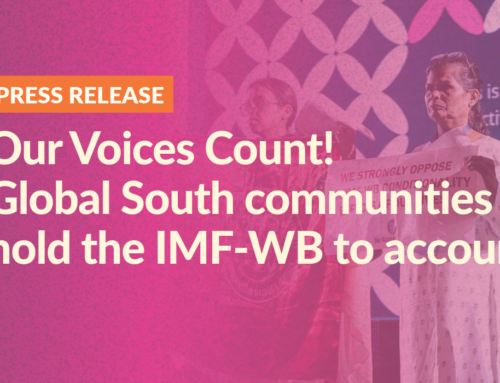
These are the outcome of decades of neoliberal restructuring imposed through debt conditionalities and enforced by global financial institutions, particularly the International Monetary Fund (IMF) and the World Bank.
For more than 80 years, neo-colonial economic policies have shaped our region: austerity measures, privatisation, deregulation, trade liberalisation and export-oriented, import-dependent development. The IMF-World Bank architecture has locked countries into cycles of debt dependence by tying financial provision to austerity measures, privatisation, deregulation and liberalisation, thereby compelling governments to cut public spending, weaken labour protections, commodify land and water and open markets to corporate and imperialist plunder.
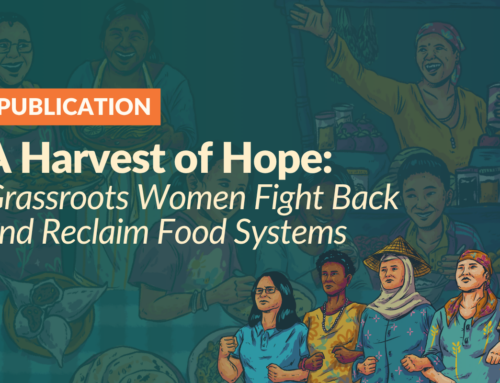
Women pay the price across these sectors. When public healthcare budgets are slashed, women take on more unpaid care work. When agriculture is liberalised, indigenous and peasant women lose land and livelihoods. When labour markets are made flexible, women’s work becomes more undervalued and precarious. When governments prioritise debt repayment over people’s needs, women’s rights are sacrificed.
It is time we name these structures and our oppressors and reject an economic order that worsens inequality while claiming to promote “development.”
At recent regional spaces, including the 13th Asia-Pacific Forum on Sustainable Development (APFSD), governments reaffirmed their commitments to the Sustainable Development Goals. Yet without confronting debt, injustice, militarism, corporate capture and IMF-World Bank conditionalities, these commitments ring hollow.
Development cannot be achieved while economic sovereignty is undermined and public goods are privatised. As we brace for the upcoming 2026 IMF-World Bank Annual Meetings in Thailand in October, we emphasise the need to advance our feminist and peoples’ demands and to resist over 80 years of destructive neoliberal policies.

Women across the region are organising for Development Justice — a framework grounded in economic justice, redistribution of wealth and power, ecological sustainability and recognition of care as central to our economies. Across the Asia and Pacific, women are resisting authoritarianism and shrinking civic spaces. Indigenous women are defending ancestral lands. Women workers and migrant women are demanding labour rights and protection. Rural women are building food sovereignty amid the climate crisis. Women human rights defenders are resisting authoritarianism and shrinking civic space.
Let us remember: March 8 was forged in resistance and solidarity — in strikes, uprisings and working women’s fight for land, jobs and rights — and it is through resistance and solidarity that our power endures.
On this International Women’s Day, we stand in solidarity with rural women, women workers, women migrants, Indigenous women and women human rights defenders resisting dispossession, land grabs, debt, militarism and corporate plunder.
Together, we are organising to dismantle the economic systems that thrive on violence and inequality and build a feminist future that puts rights, dignity, land and care before profit. ###